


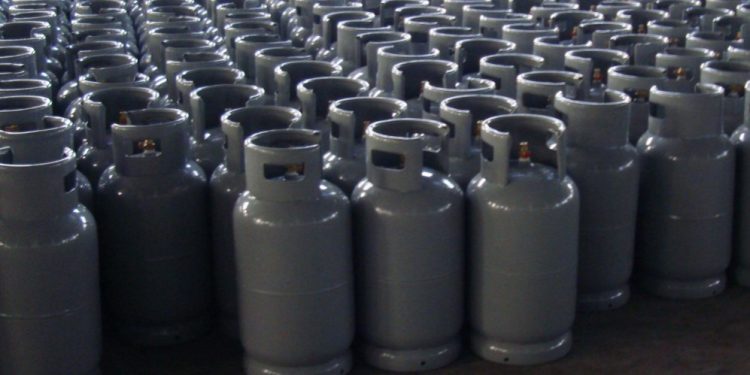
The Deputy Eastern Regional PRO of the Ghana National Fire Service has urged the public to opt for metal gas cylinders instead of transparent alternatives know as fibre cylinders, dismissing claims that metal cylinders are prone to explosions during fire outbreaks.

Fibre cylinders
Deputy Public Relations Officer of the Ghana National Fire Service, DO III (Divisional Officer Grade III) Ohemeng Adu Aaron, said metal cylinders remain the safest option for households, particularly in Ghana’s high temperature environment.
He made this revelation during an interview with host of Swiit Morning Ride, Okley Kofi Solomon also known as DJ JahSolo on Swiit90.7FM. He explained that metal cylinders are specifically engineered to withstand extreme heat.
According to him, the cylinders are manufactured under temperatures ranging between 900 and 1000 degrees Celsius, making them highly resistant to heat conditions far beyond what they would typically encounter during domestic use.
“That is what has been designed specifically for our country. It is heat resistant and produced under very high temperatures,” he stated.
His comments follow circulating claims on social media suggesting that metal cylinders are dangerous and could split into two and explode during fire due to their welded structure. However, DO III Ohemeng described such assertions as unfounded.
“I saw a comment on Facebook claiming that metal cylinders are unsafe. My question is: on what basis? The idea that a cylinder will divide into two and explode because it has been welded in the middle is simply not accurate,” he said.
He explained that the welded sections of metal cylinders are part of a deliberate industrial design. Components such as the handle and foot ring are manufactured separately and later joined using specialized, high temperature welding processes under strict factory conditions.
He cautioned the public against sending damaged cylinders to local welders for repairs, warning that such practices could weaken the cylinder’s structural integrity.
“The moment you introduce external heat outside the factory standard process, you compromise the cylinder,” he warned.
Addressing fears of explosions during fire outbreaks, Mr. Aaron stressed that metal cylinders do not burst under normal fire exposure. He noted that only extreme heat may cause minor components, such as the top handle, to detach.
“It is never true that metal cylinders will burst when exposed to fire,” he emphasized.
He further highlighted the added advantages of metal cylinders, including durability, affordability, and resilience when dropped. He also advised users to ensure regular maintenance.
“Cylinders should be taken for reconditioning or refurbishment every five to six years, and they generally have a lifespan of about 15 years,” he added.
Source: Mybrytfmonline.com/Tamara Owusu Ansah