



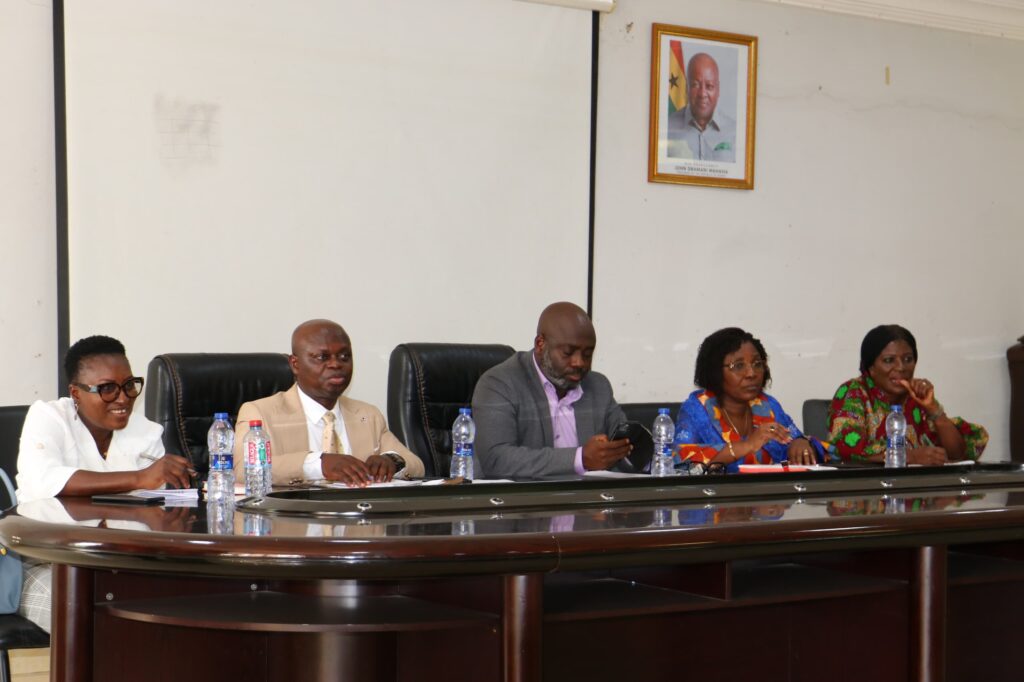
The Head of the Local Government Service (LGS), Professor Lord Mensah, has commenced a nationwide working visit to Regional Coordinating Councils (RCCs) and selected Metropolitan, Municipal and District Assemblies (MMDAs), starting with the Eastern Region.
The visit, which began on Monday, is aimed at assessing operations at sub-national level, strengthening human resource management, and gathering first-hand information to guide policy direction and management decisions within the Local Government Service.
Addressing staff of the Eastern Regional Coordinating Council, Prof. Mensah explained that the tour is necessary to move beyond desk-based administration.
He noted that effective leadership requires direct engagement with officers at the regions and districts to understand prevailing conditions and operational challenges.
“There’s a difference between sitting in an office giving instructions and going round to get first-hand information on what prevails at the various structures you are managing,” he said.
Prof. Lord Mensah outlined his vision for the Service, which is anchored on four key pillars:data driven, profesionalism,Public Private Partnership and fiscal descentralization.
Providing details about the pilllars, Prof.Lord Mensah stressed that all decisions relating to postings, promotions, deployments and resource allocation must be guided strictly by credible data, not personal relationships, ethnicity or favoritism. According to him, this approach will enhance transparency, improve service delivery and eliminate perceptions of bias and nepotism.
The Head of Service called for the building of a disciplined, competent and ethical workforce that understands service delivery standards and respects administrative protocols. He underscored that public service is fundamentally about serving citizens and commended staff for their strong attendance at the engagement.
Prof. Mensah urged RCCs and MMDAs to deliberately engage credible private sector partners to support infrastructure development, service delivery, innovation and resource mobilisation. He acknowledged that existing PPP frameworks are often too complex at the national level and indicated the need to simplify them for effective implementation at the local level.
He encouraged assemblies to go beyond merely collecting rates from informal sector operators, stressing the importance of capacity building for local businesses to ensure sustainability and consistent revenue generation.
OnnFiscal Decentralization, he noted that true decentralisation can only be achieved when local governments are financially empowered to generate and manage resources efficiently, transparently and accountably. Strengthening local financial management systems, he said, is critical for sustainable development.
Prof. Mensah expressed serious concern about indiscipline within the Service, particularly lateness, absenteeism and poor work ethics. He warned that staff who fail to adhere to official working hours—from 8:00am to 5:00pm—are effectively causing financial loss to the state and could face sanctions, including transfers.
The Head of Service revealed that management has uncovered cases where officers, sometimes with the connivance of human resource personnel, unlawfully alter their dates of birth close to retirement. He described the act as a criminal offence that undermines the integrity of the Service.
He disclosed that national security agencies have been engaged to support ongoing investigations and warned that any officer found culpable will face the full rigours of the law, in addition to administrative and disciplinary sanctions.
Chief Director at the Eastern Regional Coordinating Council(ERCC) Ebenezer Amoah said the unavailability of vehicles, poor internet connectivity, inadequate funding continue to affect the operations of the coordinating council.
Source:Mybrytfmonline.com/Obed Ansah