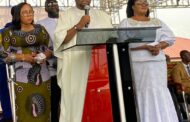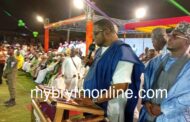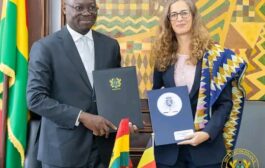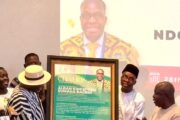


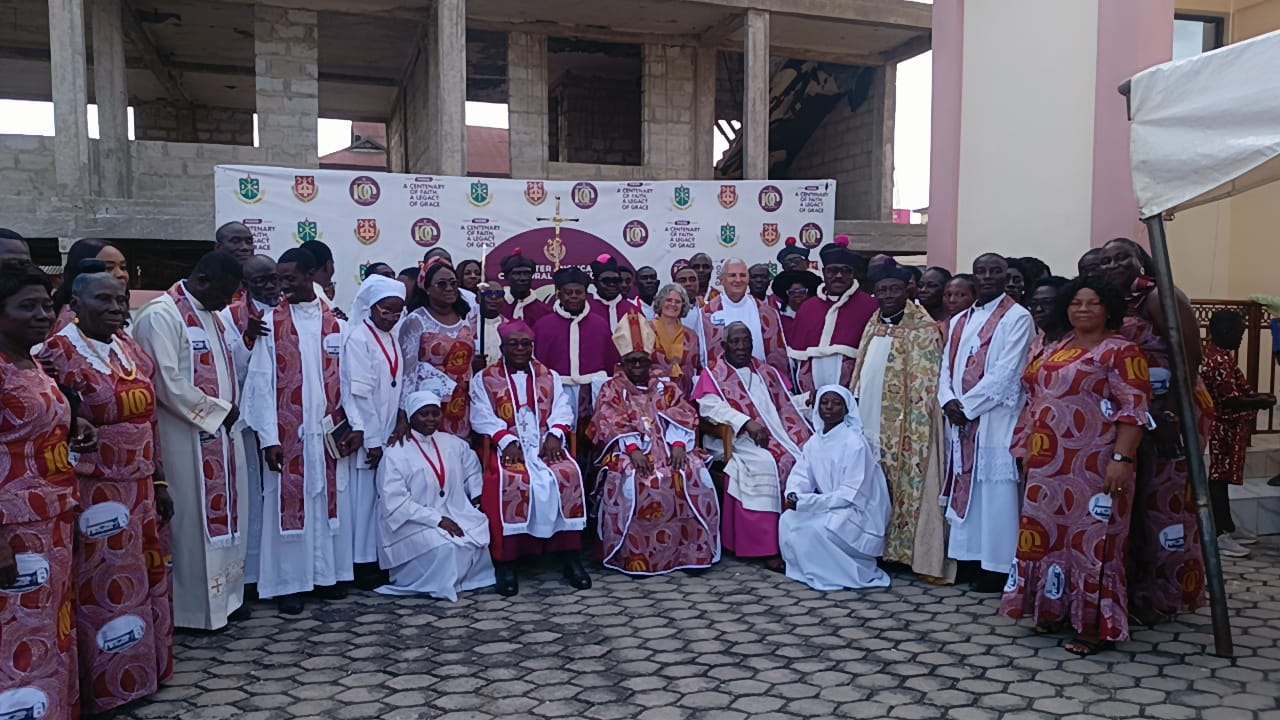
The St. Peter’s Anglican Cathedral in Koforidua has joyfully marked its 100th Anniversary and Thanksgiving Service, a momentous occasion celebrating a century of unwavering faith, service, and devotion to God. The centenary celebration brought together clergy, parishioners, government officials, and guests from across Ghana and abroad to honor the rich spiritual heritage and enduring legacy of the Cathedral.
A Century of God’s Grace
In his address, the Very Rev. Samuel Eding Paddy, Dean of the Cathedral, expressed profound gratitude to God for His abundant blessings upon the congregation over the past hundred years. He reflected on how the Cathedral has remained a sacred space where “the words of Christ have been unceasingly proclaimed, and the Holy Eucharist faithfully administered.”
Rev. Paddy encouraged parishioners to let this milestone inspire renewed faith and commitment to Christian values.
“It is my prayer,” he said, “that the joyous celebration of this anniversary will awaken in every parishioner a deeper awareness of our Christian dignity and mission, inspiring new generations to adhere sincerely to Christ and His Church.”
Tracing the Cathedral’s humble beginnings, he reminded congregants of its origins in a small cocoa shed near the railway line at Nsukwao. What began as a modest gathering of believers, he said, has now grown—through determination, faith, and sacrifice—into a magnificent house of worship that stands as a beacon of light in the Eastern Region.
“This journey did not happen on a silver platter,” he emphasized. “It took courage, unity, and profound sacrifice from both clergy and laity. To God be the glory—great things He has done, and greater things He will yet do!”
Honoring the Past, Envisioning the Future
The Dean also reflected on the symbolic importance of the Cathedral’s foundation, both spiritual and physical.
“The foundation of any structure is what holds everything together, and the same truth applies to our Cathedral,” he noted. “As we look back with gratitude, we can confidently declare: Ebenezer—thus far has the Lord helped us!”
He called upon the congregation to use the anniversary not only for celebration but also for introspection and forward vision. Paying tribute to the founding fathers and all who contributed to the Cathedral’s establishment, he described the centenary theme—“The Journey of Faith, Hope, and Love: Honoring Our Spiritual Heritage with a Vision for the Future”—as both apt and pragmatic.
“May the Holy Spirit continue to guide our church community, keeping us united with Christ in His redemptive mission,” he prayed, “and may we always cultivate a heart of service to God and humanity.”
A Call to Unity and Christlike Living
Delivering the sermon, Rev. Max Cross, Rector of Bedhampton Parish in the Diocese of Portsmouth, England, urged members of the congregation to uphold love and unity as core values of their Christian witness.
“A united church,” he said, “is a strong church. When we stand together in love, we reflect the very nature of Christ Himself.”
He encouraged parishioners to embody Christlike character in their daily lives and to be living examples of the Gospel in action.
Government Commendation
The Eastern Regional Minister, Hon. Rita Akosua Adjei Awatey, joined the celebration and extended warm congratulations to the Cathedral and the entire Anglican community.
“It is with great joy that I join the clergy, congregation, and the entire Anglican community in commemorating this significant milestone,” she said. “For a century, St. Peter’s Cathedral has stood as a beacon of grace, vision, and strength—nurturing the spiritual growth of countless individuals and contributing immensely to the moral fabric of our society.”
She encouraged the congregation to let the anniversary serve as a reminder of the enduring Christian virtues of faith, unity, and service.
“May this occasion renew our collective commitment to the work of God,” she added, “and inspire us to persevere in love and dedication.”
Hon. Awatey also commended the Cathedral’s leadership for their steadfast devotion and the positive impact they continue to make across the region. She concluded with a blessing:
“May the Almighty continue to bless the church, its clergy, and congregation with wisdom, peace, and prosperity.”
A Glimpse into the History of the Anglican Church in Ghana
The story of the Anglican Church in Ghana dates back to the arrival of the English on the Gold Coast in the 16th century, through two notable missionary societies:
The Society for the Propagation of the Gospel (SPG), founded in 1699
The Society for the Promotion of Christian Knowledge (SPCK), founded in 1701
In 1745, the SPG appointed Rev. Thomas Thompson, a missionary previously serving in New Jersey, as its representative to the Gold Coast. Motivated by a passion to educate Africans, he arrived at Cape Coast Castle in 1751 on a stipend of £70 a year. However, his mission was short-lived—he returned to England in 1756 due to ill health and the harsh climate.
Rev. Thompson’s work faced many challenges. His primary duty was to serve as a chaplain to the garrison rather than as a missionary to the local people. His misunderstanding of traditional African spirituality further limited his success. In his reports, he described the people’s faith as “idolatrous and superstitious follies,” revealing his inability to appreciate the richness of African religious traditions.
Despite these early setbacks, the foundation for Anglicanism in Ghana was laid. Among those influenced by the SPG’s efforts was Philip Quaque, a young Fante who studied in England and became the first African ordained priest in the Church of England after the Reformation. In 1765, he was appointed Missionary Schoolmaster and Catechist to the Negroes on the Gold Coast, returning home in 1766 to serve faithfully for 50 years.
Though his mission also faced difficulties—largely because he tried to Europeanize rather than contextualize Christianity—Philip Quaque’s legacy endures. His pioneering work in education and faith laid the foundation for the establishment and growth of the Anglican Church of Ghana, whose influence now spans every corner of the nation.
Conclusion
As St. Peter’s Anglican Cathedral, Koforidua, celebrates its centenary, it stands not only as a historical landmark but as a living testament to the resilience, devotion, and faith of generations of believers. From a humble cocoa shed to a grand cathedral, its story embodies the very journey of faith, hope, and love—a journey that continues to shape lives and transform communities in Ghana and beyond.
To God be the glory—great things He has done, and greater things He will do.
Source:Mybrytfmonline.com/Nhyiraba Solomon Nartey