

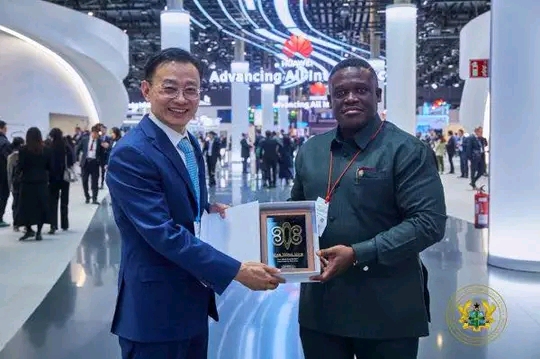
The Minister for Communications, Digital Technology and Innovations, Samuel Nartey George has struck a deal with Huawei Technologies to provide free AI training for girls in Ghana as part of the government’s flagship ICT for Girls Program.
The Minister got Huawei to make that multi-million dollar commitment in a meeting with the Senior Vice President of Huawei, Steven Yi at the ongoing Mobile World Congress (MWC26), in Barcelona, Spain.
In an exclusive interview with Techfocus24 after the meeting, the Minister explained that Huawei expressed interest in Ghana’s technology ecosystem, particularly the US$250 million AI Compute Centre to be built, rural telephony and also the rollout of 5G technology in Ghana.
On the back of the interest expressed by Huawei, particularly in the area of rural telephony, the Minister insisted that the company needs to give back to the country by way of free AI training under the ICT for Girls Programme, which Huawei completely agreed to do.
He noted that currently, the Girls in ICT Programme has modules on coding, animation (scratch), and basic computing skills over the two-week period that the girls participate in the program.
“But with Huawei coming on board, we are going to have a crash program in AI skills,” he said. “For me this is critical because once the girls get training in AI, as soon as they finish they can jump on my One Million Coders Programme and get further training there – this means we are catching them young.”
Sam George said for this year, the Huawei Senior Vice President has instructed the Huawei Ghana office to work with GIFEC (Ghana Investment Fund for Electronic Communication) and the ministry to rollout the AI training for the 3,000 girls under the Girls for ICT Program.
Huawei Device Assembling Plant in Ghana
The Minister also stated that he had discussions with Huawei the possibility of setting up a handheld devices assembling plant in Ghana to produce affordable smart handheld devices for both the Ghanaian market and its neighbouring countries.
This move is in line with an initiative by the GSMA and its seven partner OEMs (original equipment manufacturers) like Huawei and others and six leading African telcos to provide $40 smart handheld devices across Africa. The initiative will first be piloted in six countries before being spread across the continent.
Sam George said he has made a representation to the GSMA to allow individual countries like Ghana to make a pitch to each of the seven OEMs so the OEMs can make a business decision on where to locate their assembling plant based on what each country offers.
He is confident that with Ghana’s relative political stability, position as a gateway to West Africa, thriving economy, free zones enclave and the flexibility for multinationals to recoup and repatriate their profits, the country is well positioned to host a device assembling plant.
“We made a clean headway on that front with Huawei and so we look forward to that as well,” said. “I however made it clear to Huawei that quality and affordability is critical and we will not compromise on that.”
On the issue of affordability, Sam George noted, for instance, that whereas Ghana has over 90% 4G coverage, usage is lower than 60% and that is because a lot of the people who have coverage can’t afford smartphone so the use feature phones which cannot access 4G.
He is therefore hopeful that once Huawei sets up the affordable handset manufacturing plant in the country, a lot more Ghanaians will have access to 4G and even 5G enabled devices to close the usage gap.
Source:Mybrytfmonline.com/Kwabena Nyarko Abronoma