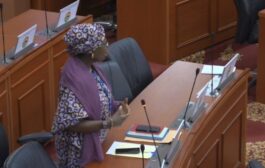



The University of Environment and Sustainable Development (UESD) in Somanya, Eastern Region has formally responded to a recent publication by The Fourth Estate, describing it as inaccurate, misleading, and based on incomplete information.
The investigative report, published on June 26, 2025, alleged that the University recruited an unqualified Internal Auditor and raised concerns about the credentials of its Director of Physical Development and Estate Management, claiming these appointments bypassed laid-down recruitment procedures.
In a detailed rejoinder signed by the University’s Registrar, Mrs. Mary Abena Agyepong, the University acknowledged The Fourth Estate’s effort to promote accountability but rejected the claims as largely based on an interim report of the Credentials Vetting Committee (CVC), not the final report officially adopted by the University’s Governing Council.
Clarifications by UESD:
The University explained that all senior appointments — including those of Directors and Professors — were approved by the Governing Council at its 7th meeting on November 12, 2020, following thorough assessment of recruitment panel reports. It emphasized that appointment letters were only issued after Council’s formal approval.
The University also dismissed as false claims by a former Governing Council Chairman, cited in the publication, that appointments were hurried because “students had arrived and teaching had to commence.” According to UESD, at the time no students had been admitted, and the appointments in question were for administrative roles unrelated to teaching.
In addressing concerns about the credential verification process, the University confirmed that it began an institutional-wide vetting exercise in June 2023 after a directive from the Governing Council. The Credentials Vetting Committee (CVC) was tasked to verify staff qualifications, beginning with key officers.
The University acknowledged that initial concerns raised by staff unions centered on procedural issues, particularly regarding the resubmission of already submitted documents for a pending audit by the Ghana Tertiary Education Commission (GTEC) — not resistance to the vetting itself.
On Internal Auditor and Director of Estates
UESD confirmed that Mr. Emmanuel Opoku Ware, then Director of Internal Audit, was dismissed on June 5, 2024 after the final CVC report found his certificates unverifiable.
On Surveyor Isaac Abbam, Director of Physical Development and Estate Management, the University clarified that he was ranked third, not fifth, in the interview process, and was selected based on qualifications, operational suitability, and Council’s strategic considerations. The claim about a higher-scoring applicant being overlooked, the University says, related to a different, lower-level position.
Financial Constraints Affected GTEC Credential Audit
The University further noted that although it planned to engage GTEC for an external audit of staff credentials in 2023, financial challenges in its early years delayed the exercise. Nonetheless, it affirmed that a comprehensive verification process remains ongoing.
Call for Balanced Reporting
The University expressed disappointment that The Fourth Estate allegedly failed to request or reference the final CVC report, which it said would have clarified several of the issues raised. It urged the publication to give its rejoinder the same prominence and visibility as the original story, in line with journalistic ethics.
Below is the detailed Rejoinder by the University
UNIVERSITY OF ENVIRONMENT AND SUSTAINABLE DEVELOPMENT, SOMANYA
FORMAL REJOINDER:
“FAKE CREDENTIALS: GHANAIAN UNIVERSITY FORCED TO DISMISS INTERNAL AUDITOR, CENSURES FACILITIES MANAGER”
The University of Environment and Sustainable Development (UESD) has
sighted a publication on, June 26, 2025, authored by a Thelma Dede
Amedeku of The Fourth Estate which reportage alleges that the University
authorities’ failure to follow laid-down procedure has led to the recruitment of an unqualified Internal Auditor and the “flagging” of the credentials of the Director of Physical Development and Estate Management by the Vetting committee set-up by the University’s
Governing Council.
I have instructions from the Vice-Chancellor to state that the University
acknowledges The Fourth Estate’s application of industry to gather
information and publish this report. However, the University notes the
inaccuracies in the story and clarifies as follows:
- That the University is of the view that The Fourth Estate report in question was largely based on an interim report of the Credential Vetting Committee (CVC) other than the Final Report.
- That, the appointment of Directors of the various Directorateswithin the University is made by the Governing Council, which is the highest decision-making body of the University.
- That the University Management could not have issued appointment letters to Directors and Professors without approval from the Governing Council.
- Requirements for staff recruitment followed set by the University’s
Governing Council in consultation with Ghana Tertiary Education Council (GTEC). Such requirements were published in the dailies and on online portals. - That the report indicating that management proceeded with the
appointments and issued letters without proper Council involvement is untrue. The Council approved the appointments of all categories of staff, including the two Directors in question. This
was after the Council assessed and deliberated on extracts of reports
from the recruitment panels constituted by the Governing Council to conduct the interviews. The form and details of the extract from the said report were based on certain requirements by the Council
and were presented at the 7th Council meeting held on November 12, 2020. - That the statement of the former Chairman of the Governing Council in the report that “when a summary of the appointments was eventually presented, he questioned the procedure, but as students had already arrived and teaching needed to commence, the process could not be delayed” is also untrue. The University at that time had not admitted students for teaching to start as the former Chairman sought to
portray in the story. It is also important to note that these appointments in question were for Directors who had no stake in the teaching of students.
Therefore, if the former Chairman indeed had reservations with the procedure, he could have addressed through the appropriate means.
- The University therefore states with utmost certainty that the
former Chairman together with the University Council did not find
any wrong with the appointments that was why Council approved
them. Indeed, all appointment letters were issued after the 7th
Council meeting of November 12, 2020. - That it is noteworthy that the University had just begun operations
with the appointment of only three key officers namely the Vice-
Chancellor, Registrar and Finance Director. The Council subsequently approved the maiden recruitment exercise, and was actively involved in all the processes, including the placement of advertisements in the dailies and on social media, to the shortlisting of applicants, setting up of interview panels, and determination of
the deadline for the issuance of appointment letters. - That as part of the process of quality assurance in the recruitment process, staff certificates and credentials were to be further subjected to another layer of scrutiny to ensure that all documents were verified adequately as authentic.
10.That indeed one of the regulatory functions of the Ghana Tertiary
Education Commission (GTEC) is to assist tertiary educational institutions to audit staff qualification and placements. Pursuant to this, the University received a letter from GTEC dated May 29, 2023,indicating its readiness to begin the audit process. Documents submitted to GTEC for the exercise included soft and hard copies of all certificates and other staff credentials required for the said
exercise.
11.That the University, however, was unable to pay the associated fees
to GTEC for the said verification and placement exercise, as the University had just begun operation and had very low number of students and was facing dire financial challenges.The Council was fully aware of the University’s financial situation. Consequently, the verification exercise was rescheduled to a later date when the University’s financial position improves.
12.That its 16th meeting held on 15th June, 2023, the Governing Council
discussed the issue of a fake certificate incident at a sister University, which subsequently led to the establishment of a Credentials Vetting Committee.
13.That the Credentials Vetting Committee was tasked to vet credentials of all staff beginning with the Acting Pro Vice-Chancellor, the three (3) Deans, and all the Directors.
14.That the University states emphatically as inaccurate, the statement attributed to the former Chairman that the staff members seeking clarity of the vetting was a ‘pushback’ by the various staff unions.
The concern raised by the unions was in relation to the Human Resource Division’s request for staff to resubmit their certificates and credentials in preparation for the credentials and placement audit to be conducted by GTEC. While staff complied with the request, the leadership of the unions noted that resubmitting documents already submitted to GTEC would amount to unnecessary duplication and therefore advocated for the use of the documents previously submitted. Additionally, the unions expressed concern over the lack of any internal representation on the Credentials Vetting Committee.
The University wishes to throw more light on the matter by stating
that a. the joint letter from the Staff Unions was to seek clarity on the
rationale behind the vetting exercise. Specifically, to understand the purpose, nature and process to be undertaken in the vetting exercise.
b. it is also important to note that every University is governed by
a Council. The make-up of such Councils includes representatives of the various staff constituencies. Just like other
members of the University Council, these representatives also have the right to share their opinions, ask questions, contribute to debates and vote on matters during Council meetings.
15.That at an Emergency Council meeting (17th), held on 23rd August,
2023, the Council, after extensive deliberations, resolved that the
Credentials Vetting Committee should proceed with the vetting process using the documents previously submitted to the Human Resource Division. Furthermore, the Council approved the inclusion of two internal members, nominated onto the Credentials Vetting Committee by the Vice-Chancellor as directed by Council.
Subsequently, the Credentials Vetting Committee enjoyed the full
cooperation and support of the staff unions in the execution of its
mandate.
Matters Relating to Mr. Emmanuel Opoku Ware
16.That the Credentials Vetting Committee in its findings could not
verify the authenticity of some of the certificates of the impugned
Director of Internal Audit and therefore recommended that his
appointment be terminated forthwith.
17.That the University’s decision to settle on Mr. Emmanuel Opoku
Ware was based on the applicant’s long industry experience as
submitted during the recruitment process. It is important to note
that the alternative candidate did not possess the post-qualification
experience for the role of Director in the event that Mr. Opoku Ware
had not been appointed.
18.That the University Council, on June 5, 2024, terminated the
appointment of Mr. Emmanuel Opoku Ware on the recommendations of the Final Report of the CVC, and in compliance with the University’s Statutes and the Internal Audit Agency Act,
2003 (Act 658).
19.That the University Governing Council has since appointed a new
Director of Internal Audit who assumed office in January 2025.
Matters Relating to Surveyor Isaac Abbam
20.That the Council agreed with the CVC that Surveyor Isaac Abbam’s
PhD certificate was not a pre-requisite to his appointment as Director of
the Physical Development and Estate Management. The University
states categorically that this in no way should be misconstrued to
condone fraudulent misrepresentation of persons for whatever
purpose.
21.That the University Council, on June 5, 2024, on the
recommendations of the Final Report of the CVC, Surveyor Abbam
was instructed to “desist from carrying himself about as a PhD holder”.
This recommendation was implemented to the letter.
22.That your innuendo suggesting a trend of picking applicants who
scored low marks ahead of top-scorers, the University wishes to register its displeasure in such a statement as The Fourth Estate could have easily found out the real state of the situation.
Indeed, if The Fourth Estate had expanded the search scope to include the final report from the Credentials Vetting Committee, they would have
come across the response to that issue which was captured in the Interim Report presented to the University Council. The Fourth Estatecould have at the very least, reached out to the University for more
information on this specific issue before publishing.
23.That Surveyor Abbam was ranked 5th with a score of 76 and was picked
over the top scorer with 78 is untrue and disingenuous. This is explained as follows:
a. That the report misrepresented the interview and the shortlisting marks, an issue the CVC put to rest after review
of its interim report.
b. The need for interviews is to allow for the appointing authorities to interact with the shortlisted candidates. All the
candidates passed the interview and having passed, the appointment was based on which candidate best met the
strategic and operational needs of the institution.
c. Five candidates were interviewed for the role. Contrary to what was reported, Surveyor Isaac Abbam was ranked 3rd,
not 5th, in the interview process. The candidate who placed 2nd informed the panel of his preference for a role in IT
Infrastructure Development, which did not align with the available position in Physical Development. Consequently,
two candidates—an Architect and Surveyor Abbam—were shortlisted and presented to the Governing Council for
consideration.
The Council selected Surveyor Abbam based on his qualifications, background in quantity surveying, and
alignment with the operational needs of the University at the
time.
24.It is also important to note that the other claim that another applicant scored higher than Mr. Abbam and yet he was denied is absolutely false since the matter was clarified in the final report
from the CVC.
The final report clarified that the said applicant was the top scorer in the category for Senior Development and Estate Management Manager, a position significantly junior to, and distinct from, the role of Director of Physical Development and Estate Management.
It is therefore regrettable that the report could skip this information as clearly stated in the Final Report of the CVC and present the story to the public in such manner.
Related Matters
25.That the University Management wishes to use this opportunity to
inform the public that the staff credentials verification is an ongoing
process which is scheduled to continue until all staff certificates are fully vetted and authenticated.
The University’s recruitment process incorporates multiple levels of
verification, including the following:
(i) Submission of police reports by applicants – which is largely
expected to form the basis of an applicant’s good standing in
society,
(ii) Submission of proof of verification of their credentials from
GTEC as part of the documents to be submitted to the
University,
(iii) Periodic audit of staff certificates and credentials by the
University’s Directorate of Internal Audit, and (iv) Periodic certificates and credentials audit by the GTEC as part
of their institutional review mandate.
These measures serve as essential safeguards to ensure that applicants’ certificates and credentials are thoroughly vetted both prior to appointment and throughout their continued employment with the University.
26.And that the University is resolute in applying all recommendations
of the CVC mandated to carry on the exercise.
27.That while the University commends The Fourth Estate for their crusade for accountability especially within public institutions such as University of Environment and Sustainable Development, the University would have very much appreciated if the publication
had been done without innuendoes. In the University’s correspondence with The Fourth Estate, a clear willingness was
expressed to provide any information they requested in the interest of ensuring that any report published would reflect the true state of affairs.
28.That the University would have appreciated it if The Fourth Estate
had posed specific questions to elicit specific responses, rather than asking general questions while expecting detailed answers.
The University also wishes to clarify that no one needed to ‘push the Vice-
Chancellor’ to provide information, as inaccurately stated in the publication. The Vice-Chancellor willingly responded to all the questions presented in the questionnaire he had requested and was duly provided with by The Fourth Estate.
29.That if The Fourth Estate had asked questions relating to the Interim
CVC Report, the University would have informed them of the
existence of a final report. This could have helped clear issues. The
story suggests that The Fourth Estate spoke to a member of the past
Council. In order to ensure a balanced and more credible reportage,
the University wishes that The Fourth Estate had spoken to the
Chairman of the CVC also for his perspective.
30.That in the circumstance, it is the University’s belief that the
questions asked by The Fourth Estate were appropriately answered
by the University.
31.Finally, the University wishes to affirm its commitment to deliver on its mandate of building a “University of the future and for the future for the continuous protection and sustenance of the environment and
survival of humankind”
32.With all twenty-seven (27) undergraduate and three (3)
postgraduate academic programmes accredited by the GTEC, the
successful graduation of our first cohort in November 2024, the commencement of postgraduate studies, and preparations underway to celebrate our five-year anniversary, the University
stands poised to give HOPE, —Honesty, Opportunity, Perseverance, and Enterprising—to the world.
33.In view of the wide circulation and public interest generated by the
initial publication by The Fourth Estate, which possess the potential to mislead the public and damage the reputation of the University, we respectfully demand that this rejoinder be given the same
prominence and visibility across all platforms where the original story appeared. This is in line with the principles of balanced journalism, the right to a fair hearing, and ethical media
responsibility.
Thank you for your co-operation.
Mrs. Mary Abena Agyepong
REGISTRAR
FOR: VICE-CHANCELLOR
11.07.2025
Source:Mybrytfmonline.com/Obed Ansah