

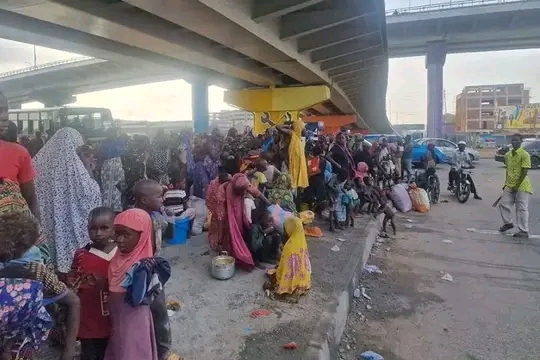
A local governance expert, Issaka Amon Kotei, has raised concerns about enforcement gaps and systemic challenges following a directive by the Ghana Immigration Service to intensify its crackdown on exploitative migrant street begging networks in the Ashanti Region.
Speaking on Bryt Adekyee Mu Nsem, he noted that while the move is necessary, the issue is deeply rooted in societal values and economic realities that complicate enforcement efforts.
“Ghanaians, by virtue of our religious beliefs, are taught to give to the needy,” he said. “As a result, we naturally have compassion and are often willing to share the little we have. Unfortunately, some individuals have studied this and turned it into a business.”
According to him, the commercialization of street begging has evolved into a structured activity, with some actors deliberately exploiting public sympathy for profit. He revealed that in certain instances, vulnerable children are used as tools to solicit alms from motorists and pedestrians.
“Some people even use other people’s children, placing them by the roadside to beg for money,” he explained. “What started as a local issue has now grown into a broader West African agenda.”
He further indicated that the phenomenon is no longer confined to Ghanaian nationals but involves migrants from other countries, including Niger, who are allegedly brought into the country to participate in organized begging networks.
“It is no longer just about people begging to survive. It has become a business, and in some cases, people are brought in from other African countries specifically for this purpose,” he added.
While Ghanaian law frowns on street begging, the local government expert questioned whether the Assemblies have the logistical capacity to enforce the law effectively.
“If an assembly arrests someone for street begging, where do you take the person?” he asked. “Do you have facilities to accommodate them, feed them, or even provide basic sanitation? These are the practical challenges we must address.”
He stressed that without adequate infrastructure and social support systems, enforcement actions risk being ineffective or unsustainable.
Mr. Kotei also pointed out that many individuals involved in street begging often transition into other informal activities, such as selling small items or cleaning car windshields at traffic intersections, further complicating the issue.
“When you look at it critically, some have moved from begging into selling blades or cleaning car glasses at traffic stops. All these activities, in one way or another, point back to broader immigration and socio-economic challenges,” he said.
He concluded by emphasizing the need for a coordinated national response that goes beyond enforcement, calling for collaboration between local assemblies, immigration authorities, and social welfare institutions to address the root causes of the problem.
Source:Mybrytfmonline.com/Joseph Asare