

The University of Environment and Sustainable Development (UESD) Nkabom Collaborative is shifting its focus from youth training to creating concrete employment and entrepreneurship opportunities for beneficiaries.
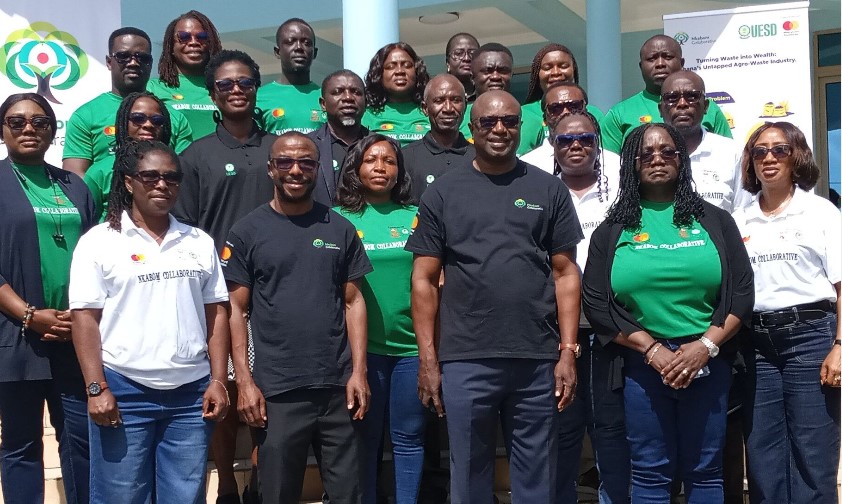
The move was highlighted during a three-day project retreat held in Koforidua to assess the implementation of the initiative and develop strategies to improve the transition of trained youth into decent work and sustainable businesses.
The retreat brought together members of the project team to review progress, identify implementation challenges and strengthen strategies for achieving the project’s targets.
The Nkabom Collaborative is a partnership involving UESD, the University of Ghana, Kwame Nkrumah University of Science and Technology, the University of Health and Allied Sciences, Ashesi University, the Association of Ghana Industries and McGill University.
With support from the Mastercard Foundation, the initiative seeks to equip 55,000 Ghanaian youth, particularly women and vulnerable groups, with skills in entrepreneurship, agro-waste management and aquaculture.
Professor Eric Nyarko-Sampson, Principal Investigator of the UESD Nkabom Collaborative Project, said the project was now placing greater emphasis on ensuring that training translated into employment and self-employment opportunities.
He said skills acquired in areas such as aquaculture, compost development and fish technology must be linked to viable economic opportunities to create sustainable livelihoods for beneficiaries.
According to him, the project was strengthening mentorship, business incubation, job matching and partnerships with industry to support beneficiaries beyond the training stage.
Prof. Nyarko-Sampson said the retreat also provided an opportunity for the team to review the Year Three Project Implementation Plan (PIP), including its strategic objectives, key performance indicators and annual targets.
He identified coordination and procurement as some of the areas requiring greater attention, explaining that delays in the importation of project equipment could affect implementation timelines.
He therefore stressed the need for early submission of procurement requests and strict adherence to national procurement procedures to ensure the timely acquisition of equipment and other resources.
Under the Year Three implementation plan, the Collaborative aims to train 500 young people, with at least 200 expected to secure employment or become self-employed.
The project will also provide mentorship and career coaching to 300 participants, engage 40 business mentors and advisers, and admit 20 youth- and women-led enterprises into its incubation programme.
An additional 50 enterprises will receive mentorship and coaching through the UESD Entrepreneurship and Innovation Hub.
The job-matching component is expected to register 500 beneficiaries, facilitate 100 internship and apprenticeship placements, and link at least 200 beneficiaries to employment or enterprise opportunities.
The project further targets the formal registration of 20 enterprises, support for 15 enterprises to access finance or investment, and market linkages for 20 businesses.
The Collaborative also aims to mobilise at least GH¢1 million in investment to support the growth of participating enterprises.
Professor Edward Debrah Wiafe, UESD Project Coordinator for the Nkabom Collaborative, said approximately 200 young people had already received training under the initiative.
He explained that the project’s priority was now to create practical pathways that would enable trained beneficiaries to enter the labour market or establish sustainable businesses.
Prof. Wiafe said stronger partnerships with industry, internship opportunities, mentorship and access to markets would form a key part of the transition from training to employment.
He added that training and start-up support would also be extended to underserved, deprived and island communities to ensure that vulnerable groups were not left behind.
For beneficiaries interested in establishing businesses, he said the project would provide practical coaching in bookkeeping, basic accounting and record-keeping to help them manage their enterprises effectively.
Prof. Wiafe stressed that the initiative was designed to promote sustainable employment and entrepreneurship rather than create dependence on government support.
He further explained that the project was encouraging young people to convert agricultural waste into useful products such as biochar, creating economic opportunities while helping to address environmental challenges in the Eastern Region.
The retreat also placed emphasis on inclusion and post-training monitoring to determine whether beneficiaries were successfully transitioning into employment and sustainable businesses.
Women, persons with disabilities, rural youth and other underserved groups are expected to benefit from the training-to-work pathway.
Beneficiaries and supported enterprises will be monitored after six, 12 and 24 months to assess employment outcomes, income levels, business growth and the number of jobs created.
The project team says the shift towards employment, enterprise development and long-term monitoring is intended to ensure that the skills acquired by beneficiaries translate into sustainable livelihoods and measurable economic impact.
Source:Mybrytfmonline.com/Nhyiraba Solomon Nartey