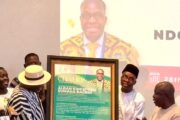



Prof. Vincent Adzadhlie Mensah, the Principal of the Seventh Day Adventist College at Asokore in the New Juaben North Municipality of the Eastern Region has advised policy makers in-charge of education to reconsider the curriculum being used in schools.
As the main speaker at the 51st Conference of Managers of Education Unit (COMEU) in Koforidua – Eastern Region, Prof. Vincent Adzadhlie Mensah, raised concerns about what he described as a “poisonous pedagogy ” in Ghana’s educational system.
He explained that a poisonous curriculum is one that discourages innovation, critical thinking, and open discussion. Instead, it restricts learners to memorizing their way throughout school in pre-packaged knowledge, leaving no room for creativity, critical problem solvers using rare alternative ideas.
According to him, this approach overloads children with irrelevant content, much of which has little or no immediate practical application on their lives and society.
Prof. Mensah bemoaned how children as young as six or seven years are being taught about the solar system when they have not fully understood their immediate environment yet!.
He argued that such practices create learning gaps and disconnect students from reality.
The professor further criticsed why Ghana is identified as an agrarian nation with over 60% of its population relying on agriculture yet, the subject is still not compulsory in our schools from basic to tertiary!!!.
Instead, agriculture is merged into broader subjects like Integrated Science and Natural Science. He suggested that schools should allow children from schools to engage in basic farming activities, even if on a small scale, to instill practical skills and knowledge on farming.
Professor Mensah also raised concerns about the teaching of ICT in schools without the necessary tools and accessories, describing it as harmful to learners.
He’s calling for a paradigm shift from the current standardized based educational system to an outcome-based education model, stressing that that such approach would empower learners to become critical thinkers, identify problems, and work towards practical solutions, thereby making education more meaningful and impactful.
Source: Mybrytfmonline.com/Florence Ceaser