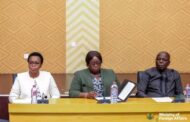


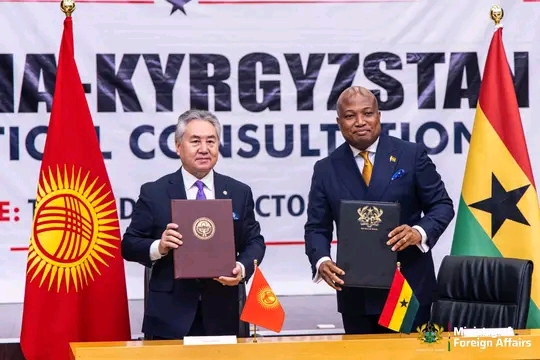
Ghana and the Kyrgyz Republic have reaffirmed their commitment to deepening bilateral relations and advancing cooperation across a range of strategic areas following the inaugural Ghana-Kyrgyzstan Political Consultations held in Accra on Thursday, 1st October, 2026.
The Consultations were led by the Minister for Foreign Affairs, Honourable Samuel Okudzeto Ablakwa (MP) and his Kyrgyz counterpart, His Excellency Zheenbek Kulubaev.
In his remarks, Hon. Ablakwa welcomed his Kyrgyz counterpart and his delegation to Ghana and described the engagement as an important milestone in the evolving relations between the two countries. He recalled his official visit to Bishkek in March 2026, which marked the first official visit to the Kyrgyz Republic by an African Foreign Minister and opened a new chapter in Ghana-Kyrgyzstan relations. He also congratulated Kyrgyzstan on its election as a non-permanent member of the United Nations Security Council for the 2027-2028 term and reaffirmed Ghana’s readiness to work closely with Kyrgyzstan.
For his part, H.E. Kulubaev expressed appreciation to the Government and people of Ghana for the warm reception accorded him and his delegation, as well as for Ghana’s support for Kyrgyzstan’s successful bid for a non-permanent seat on the UN Security Council. He conveyed greetings from the President of the Kyrgyz Republic, H.E. Sadyr Japarov, and highlighted Kyrgyzstan’s interest in expanding its engagement with Africa, with Ghana identified as an important partner and potential gateway to West Africa. He reaffirmed Kyrgyzstan’s readiness to work with Ghana in advancing the interests of developing countries and promoting a more representative and effective multilateral system.
Discussions identified agriculture, education, mining, digital transformation, sports, healthcare and people-to-people exchange as key areas for enhanced cooperation, with discussions also covering trade and investment, livestock development, scholarships, climate change, tourism and emerging technologies, including artificial intelligence. Both sides further agreed to strengthen coordination on matters of common interest, including United Nations Security Council reform, international peace and security, sustainable development, climate change and the representation of developing countries in global decision-making.
The Consultations concluded with the signing of three (3) Memoranda of Understanding (MoUs), which were;
Source:Mybrytfmonline.com/Kwabena Nyarko Abronoma